Although most of our research is focused on diamondback terrapins, we try to never lose sight of the fact that by helping the terrapins hopefully we are also conserving the other organisms in the bay. Horseshoe crabs just so happen to be one of my favorite creatures in Barnegat Bay (other than terrapins, of course!). We commonly catch horseshoe crabs in our fyke nets when we're trapping terrapins. We've also found horseshoe crab hatchlings on Conklin Beach which is one of our terrapin nesting sites. These crabs are commonly referred to as living fossils because they have changed very little in the past 250 million years. Horseshoe crab populations are dwindling due to the high numbers of crabs that are harvested for bait and fertilization. Luckily, in 2008, the state of New Jersey banned the harvest of horseshoe crabs. Unfortunately, some people still try to harvest horseshoe crabs even though there are regulations forbidding this practice. Three individuals were just caught in Ocean City, NJ on Monday poaching horseshoe crabs. Thank goodness someone called the police!

Wednesday, May 25, 2011


Thursday, May 5, 2011
Ouch! Even more terp injuries ...


 Over the past five summers (2006 to 2010), we've captured over 2,000 terrapins in the Edwin B. Forsythe National Wildlife Refuge. Of those turtles, 17.4% have scars or open wounds from past or present injuries. Many of these injuries were caused by predators or by anthropogenic sources such as automobiles or boat propellers. I've always been interested in boat injuries considering that most of my research is based on the effects of recreational boat sounds on terrapin behavior. Of the injured terrapins we've captured in Forsythe, 18.9% of those injuries were attributed to boat propellers. It's pretty easy to tell if an injury was caused by boat strike because there is a slash mark in the terrapin's shell from the propeller. Typically, these injuries cause major damage in both the carapace (top shell) and plastron (bottom shell).
 I apologize for the graphic photos, but this is yet another example of why the terrapins in Barnegat Bay need your help. Sign up for an expedition to help save the terps this summer!
Thursday, April 28, 2011
Abby's visual ecology research
Hello terrapin enthusiasts!
Wow, so much has happened this year, I don't even know where to start!
First of all, the Drexel terrapin crew went to Chauvin, LA in November to present our research findings at the diamondback terrapin working group symposium on the ecology, status, and conservation of the diamondback terrapin. We learned a great deal about other kinds of studies being conducted on the terrapin; most of all though, we learned how much we still don't know about the terrapin, and more research is necessary to gain a greater understanding.
Over the Summer of 2010 I collected over 500 reflectance spectra from more than 60 individual terrapins. From these data I have been able to compare coloration within and among individuals, as well as model the visual system of the terrapin. From these analyses and from previous research on turtle vision, I speculate that terrapins have tetrachormatic vision (UV, blue, green, red), and communicate across all color channels, especially in the UV. Intra- and inter-specific signaling in the UV has been documented in flower-pollinator relationships as well as a signal communicating fitness to potential mates (e.g. birds, jumping spiders, ocellated lizards).
On top of all this, last March I completed my written candidacy exam, and on April 12 completed my oral exam to become a PhD candidate! Now that I am a candidate, the work has really started!
This Summer I hope to gather more reflectance spectra data, blood samples and hatchling tissue samples for genotyping, as well as design a system for measuring in situ underwater irradiance. But the only way this can be done is if you sign up to become an Earthwatch volunteer! Not only will you help me collect data to elucidate the visual ecology of the terrapin, you will get to join one of the research staff everyday to collect, track, and release terrapins. Some weeks we collect almost 100 terrapins! That's a lot of processing...so come sign up and help us out!
Wow, so much has happened this year, I don't even know where to start!
First of all, the Drexel terrapin crew went to Chauvin, LA in November to present our research findings at the diamondback terrapin working group symposium on the ecology, status, and conservation of the diamondback terrapin. We learned a great deal about other kinds of studies being conducted on the terrapin; most of all though, we learned how much we still don't know about the terrapin, and more research is necessary to gain a greater understanding.
Over the Summer of 2010 I collected over 500 reflectance spectra from more than 60 individual terrapins. From these data I have been able to compare coloration within and among individuals, as well as model the visual system of the terrapin. From these analyses and from previous research on turtle vision, I speculate that terrapins have tetrachormatic vision (UV, blue, green, red), and communicate across all color channels, especially in the UV. Intra- and inter-specific signaling in the UV has been documented in flower-pollinator relationships as well as a signal communicating fitness to potential mates (e.g. birds, jumping spiders, ocellated lizards).
In addition to the vision modeling, I have processed most of my blood and tissue samples. I hope to finish these up and send them out for genotyping so I can correlate possible differences in reproductive success with differences in phenotype (coloration). If UV patterning or coloration is a signal of fitness in the terrapin, then I may find that terrapins with a brighter UV signal may have higher reproductive success.
On top of all this, last March I completed my written candidacy exam, and on April 12 completed my oral exam to become a PhD candidate! Now that I am a candidate, the work has really started!
This Summer I hope to gather more reflectance spectra data, blood samples and hatchling tissue samples for genotyping, as well as design a system for measuring in situ underwater irradiance. But the only way this can be done is if you sign up to become an Earthwatch volunteer! Not only will you help me collect data to elucidate the visual ecology of the terrapin, you will get to join one of the research staff everyday to collect, track, and release terrapins. Some weeks we collect almost 100 terrapins! That's a lot of processing...so come sign up and help us out!
What are those orange things doing on the beach?
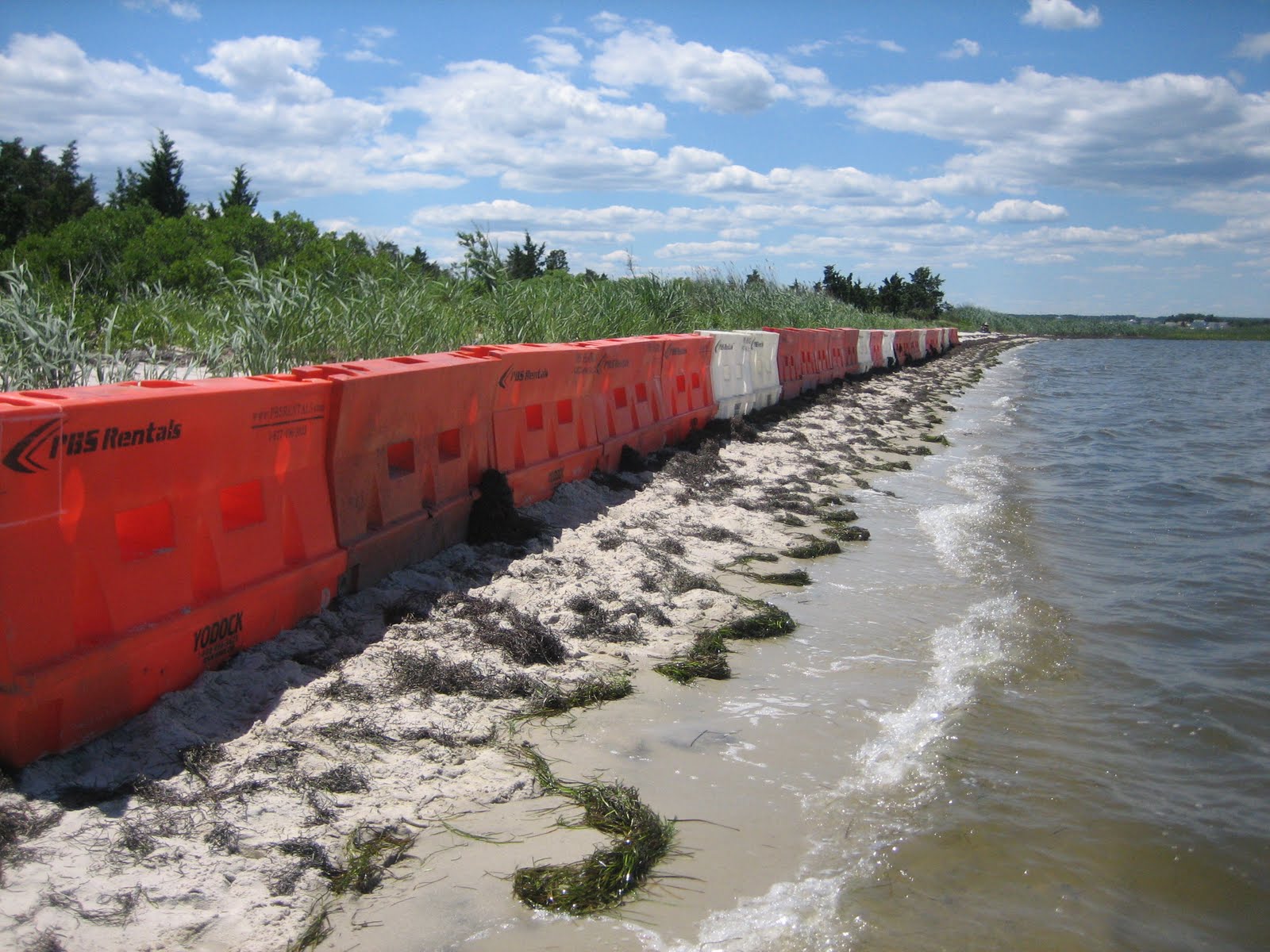 Well, they certainly do look weird - I can't really blame you for asking.
Believe it or not, they are actually being used for our terrapin research! This past summer I lined two historic nesting beaches in Barnegat with these orange construction barriers (a very kind donation from Yodock Inc.), as a form of modeled bulkheading. This is what bulkheading normally looks like in Barnegat Bay:

It's used to prevent properties' (such as this nice home on Long Beach Island) foundations from eroding away.
So, as a turtle, if this suddenly showed up on your nesting beach, what would you do?
That is my research question! And, it is a very important question to ask considering the incredibly high rate of human development occurring in Barnegat. I'm interested in seeing how much these bulkheads will displace nesting terrapins, and what behaviors they exhibit in relation to them.
Before putting the barriers in place this past summer, I wasn't sure if turtles would simply walk around the 'bulkheading' or drop their eggs in the water and run! In fact, I found that the terrapins exhibited a very high level of fidelity to the bulkheaded nesting beaches - simply walking around the barriers instead of switching sites.
Some turtles walked almost SIX TIMES further on land to nest on the bulkheaded beach. This could be a problem for these females in the long run b/c that means they are on beaches for longer periods of time, increasing their predation risk and energy allocation!
While they spend more time on land, females are spending an equal amount of time in the water "checking out" the beach before emerging to nest regardless of the barriers. This is interesting because I expected the turtles to spend more time looking at those big orange things before risking exposure to nest, wouldn't you?
 How do I know where the turtles are on land and in the water?
Great question! This turtle shows off the telemetry equipment I use to track nesting turtles. The orange transmitter on the top of her shell sends transmissions through the air when she's on land, and the white transmitter on the back of her shell sends signals through the water. Then, I know not only if the turtle is on the beach nesting or outside the beach checking things out, but also exactly where she is on land or in the water.
I plan to replicate my 2010 experiment this coming summer, so if you are interested sign up for a Earthwatch team and come try your hand at turtle nesting surveys yourself! In the mean time, I'll keep you posted...
Monday, April 25, 2011
Homing Behavior and Homeward Orientation Study
Last summer, the Earthwatch volunteers helped me track terrapins to determine whether they display homing behavior, using radio and sonic telemetry. Eight out of the nine terrapins that we tracked all returned home successfully! Sadly, one was recaptured in a crab pot. We also placed terrapins inside a 16-square meter terrestrial arena to determine if they had homeward orientation (placing terrapins inside the arena at night was the most fun). We were able to run 181 terrapins in the arena throughout the summer and have some interesting results... females tend to have a mean homeward direction while males did not. Females may be interested in locating home for nesting locations. This summer, we are going to run more terrapins in the arena and need volunteers to help. If you are interested in seeing some more of my results, a poster I recently made for a symposium is here (click on the link, then go to the file menu of google docs to download the original full version of the poster).
-Nicole
Wednesday, April 20, 2011
Need summer plans? Join us to save the terps!

For prosperity's sake, here's a snapshot of our staff from last summer. As far as I know, Dr. Avery, Dr. Standora, Dr. Wnek, Jules, Abby, Nicole, Brian, Chris, and I will still be around this summer and we'll be joined by a few new faces.

Stay tuned to hear more about our research in the next few days!
Tuesday, April 19, 2011
Terrapin Hatchling Update

In 2010, we retrieved over 60 terrapin hatchlings from North Sedge Island as part of a head-start program. Since that time, six schools raised hatchlings including: Girard Middle School (PA); Lacey Middle School (NJ); Scotch Plains Elementary School (NJ); Southern Regional High School (NJ); Stafford Intermediate School (NJ) and Paterson Elementary School (NJ). We have released headstarted terrapins back to the Sedge Island Marine Conservation Zone throughout May 2011. Thanks to the students and their teachers for making this a tremendous learning experience!
Subscribe to:
Posts (Atom)